
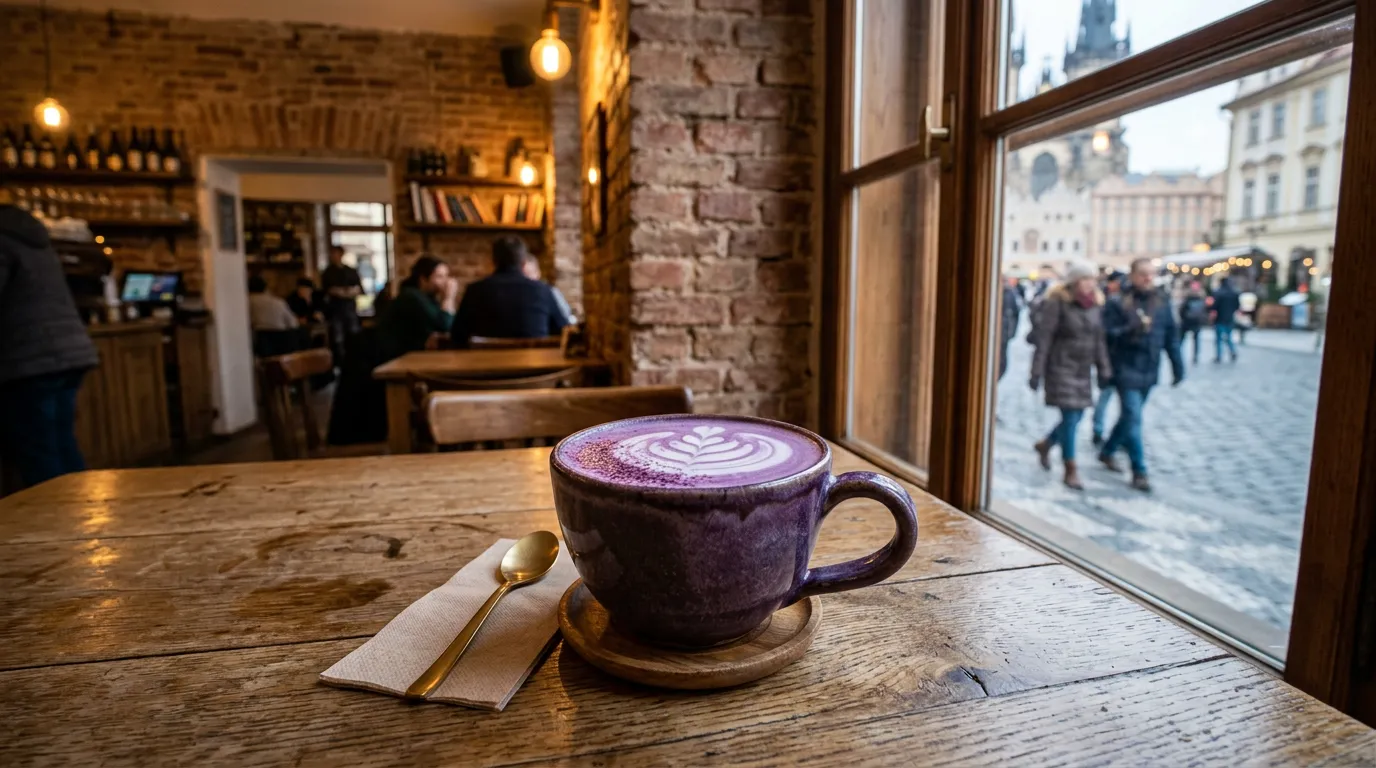
Prague’s café scene has always been a place of convergence. The city that gave the world its coffee house literary tradition, where Kafka wrote and where the kafárna remains a cornerstone of daily social life, has also always been receptive to the influences that flow through Central Europe from every direction. In recent years, a new wave of specialty cafés has brought global wellness beverage trends to the cobblestone streets of Vinohrady, Žižkov and the Holešovice market district, and among the most visually striking of these arrivals is the ube latte, the deep purple Filipino yam drink that has been conquering café menus from Manila to London.
The ube latte has arrived in Prague at a moment when the city’s café culture is more adventurous than at any point in its history, and its combination of visual impact, genuine nutritional interest and a flavour profile that is simultaneously exotic and comfortingly sweet has found an audience among the young urban professionals and international residents who populate the city’s most progressive neighbourhoods. For those who want to explore authentic ube products at home or source quality ube preparations for their own purple latte experiments, ube-latte-shop.com offers a curated selection with delivery across Europe including the Czech Republic.
What ube is and why it looks the way it does
Ube is Dioscorea alata, a yam species native to Southeast Asia that has been central to Filipino cuisine and celebration for centuries. Its most immediately striking characteristic is its colour: a deep, vivid violet-purple that runs through the entire flesh of the tuber rather than just the skin, and that survives cooking, blending and heating with remarkable stability. This colour stability is what makes ube such a compelling base for visually spectacular food and drink preparations and has driven its global social media popularity over the past decade.
The colour is produced by anthocyanins, the same class of pigments responsible for the colours of blueberries, red cabbage and açaí. In ube, the anthocyanins are predominantly in acylated form, a structural variant that is more stable during processing and gastrointestinal transit than the non-acylated anthocyanins found in most berries. This stability is one of the reasons ube preparations maintain their vivid colour so reliably and also one of the reasons the prebiotic effects of ube anthocyanins may be particularly pronounced.
The flavour of ube is genuinely distinctive: mildly sweet with vanilla undertones, a subtle nuttiness and an earthy warmth that makes it far more interesting as a drink base than the generic sweetness of purple sweet potato, with which it is frequently confused. Taro, another purple-adjacent root vegetable sometimes mistaken for ube, has a significantly more neutral and starchy flavour profile without the vanilla complexity that makes ube lattes so immediately appealing to people trying them for the first time.
How the ube latte fits into Prague’s café culture
Prague’s café culture has deep roots in the Central European coffee house tradition that flourished across the Habsburg Empire from the seventeenth century onward. The grand cafés of the First Republic era, places like Café Louvre and Café Savoy, were temples of intellectual and social life where hours could be spent over a single coffee without social penalty. This tradition of the café as a space for lingering, conversation and cultural exchange has survived the communist period and the post-1989 transformation to emerge as one of the defining characteristics of contemporary Prague urban life.
The specialty coffee wave of the 2010s introduced a new generation of Prague cafés focused on single-origin beans, precise brewing methods and an expanded menu of alternative milk beverages that prepared the city’s café consumers for the adaptogenic and functional drink trends that followed. Matcha lattes, turmeric golden milk and oat milk flat whites established a consumer appetite for colourful, flavourful alternatives to standard coffee drinks that ube lattes now satisfy with particular visual drama.
The ube latte also fits naturally into the Czech affinity for warm, comforting beverages during the long Central European winter. Prague winters, with their grey skies and temperatures that regularly fall below freezing from November through March, create a cultural demand for warming drinks that goes beyond coffee to include svařák, the Czech mulled wine, horká čokoláda and various herbal and spiced preparations. The ube latte, served warm with its sweet and comforting flavour profile, slots naturally into this winter beverage culture as a caffeine-free alternative with its own visual and nutritional identity.
Making an authentic ube latte in the Czech context
The preparation of an ube latte at home in the Czech Republic is straightforward once quality ube powder or extract is sourced. The Czech dairy tradition provides an excellent base in the form of high-quality whole milk, which produces a richer and creamier ube latte than many plant-based alternatives, though oat milk produced from Czech-grown oats has become widely available and pairs beautifully with ube’s earthy sweetness.
A standard preparation uses one teaspoon of ube powder or half a teaspoon of concentrated ube extract whisked into 250 ml of heated milk just below boiling point. Sweetness can be adjusted with a small amount of honey, Czech flower honey being a natural complement to ube’s vanilla notes, or with a natural sweetener of choice. The result is a smooth, deeply coloured purple drink whose flavour is genuinely unlike anything in the traditional Czech beverage repertoire, which is precisely part of its appeal.