
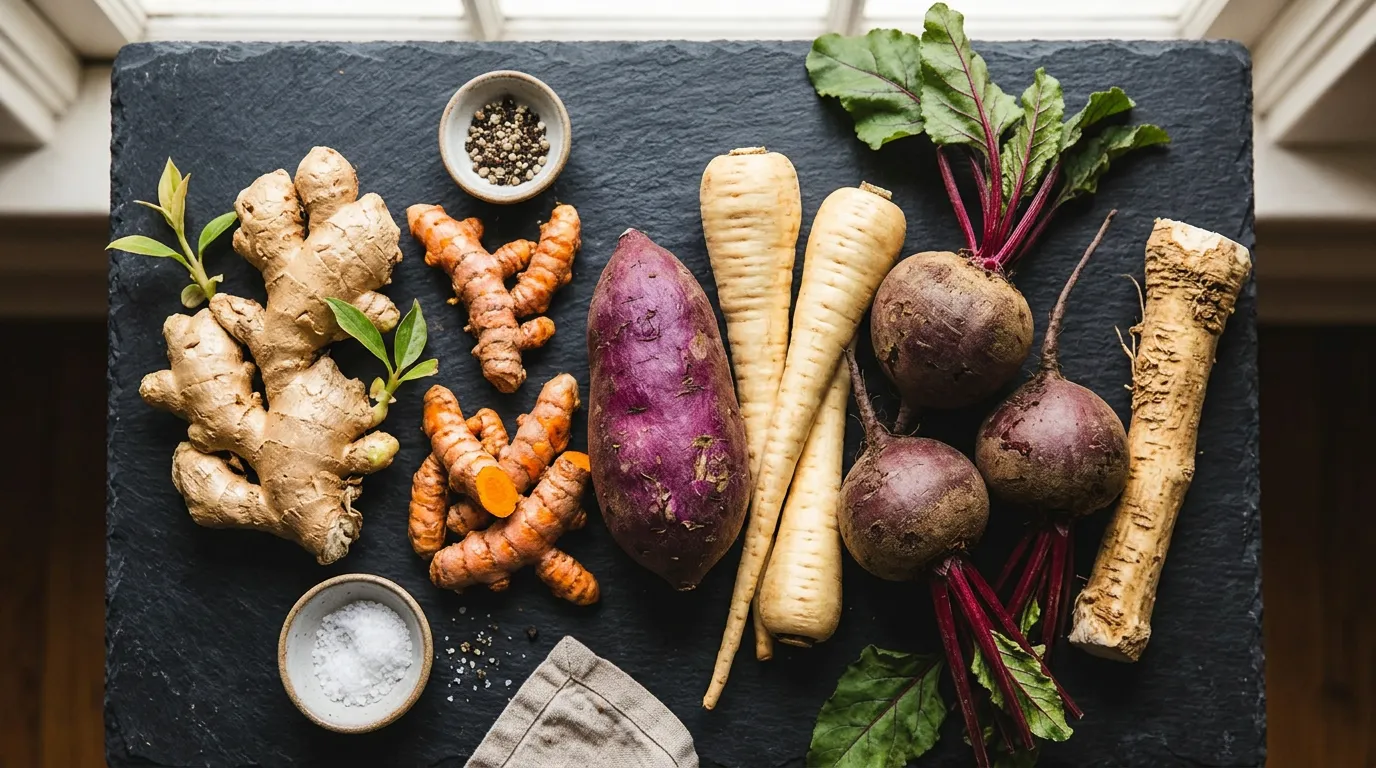
Root vegetables occupy a unique position in the culinary traditions of virtually every food culture on earth. Growing underground, protected from seasonal extremes and naturally preserved by the cold earth of autumn and winter, they have been the nutritional backbone of human diets across climates and centuries. In Czech cuisine, the parsnip, celeriac, kohlrabi and carrot define the flavour of winter soups and roasts. In Japanese cuisine, the daikon radish and lotus root are central to the repertoire of preserved and simmered dishes. In South Asian cooking, turmeric, ginger and galangal are so fundamental to flavour and medicine that they barely register as vegetables in the European sense, functioning more as essential chemical tools.
In recent years, a small group of root vegetables has crossed the boundary from their regions of culinary origin into global wellness culture, valued not only for their flavour but for bioactive compounds whose health properties have attracted serious scientific attention. Ginger, turmeric and ube, coming from South Asia and Southeast Asia respectively, now appear on café menus, in supplement formulations and in supermarket aisles across Europe and North America. Understanding what these roots actually contain, what their culinary traditions reveal about their uses and how they fit into a modern wellness-oriented approach to cooking provides a richer picture than the often superficial treatment they receive in health media.
Our guide to ube latte in Prague explores in detail how ube specifically has made its way from Filipino celebrations to Central European cafés, providing cultural and nutritional context for this particular root’s global journey.
Ginger : the universal root of warming and healing
Zingiber officinale has been in continuous culinary and medicinal use across South and Southeast Asia, China, the Middle East and East Africa for at least three thousand years, making it one of the most historically significant food plants on earth. Its cultural reach is extraordinary: ginger appears in the ancient Egyptian Ebers Papyrus as a medicinal preparation, in medieval European manuscripts as a spice of extraordinary value, in traditional Chinese medicine as a treatment for cold and dampness, and in the folk medicine of virtually every culture that has encountered it.
The flavour chemistry of ginger is produced primarily by gingerols in fresh root and shogaols in dried or heated ginger, with zingerone forming through the conversion of gingerols during cooking and adding a gentler, sweeter spiciness. This transformation of the flavour profile with heat is one of the reasons ginger performs so differently in fresh ginger tea compared to ginger powder in a baked product, and understanding it allows cooks to choose the appropriate form for each application.
In Czech cuisine, ginger appears most prominently in perník, the traditional spiced gingerbread that is one of the most beloved components of the Christmas season, and in zázvorák, a ginger-flavoured spirit. These uses connect Czech food culture to the same medieval spice trade routes that brought ginger to Central Europe from its South Asian origins. Contemporary Czech cooking has expanded this use to include fresh ginger in soups, dressings and warm drinks in ways that reflect the broader globalisation of Czech culinary culture since 1989.
The anti-inflammatory evidence for ginger is among the most robust in the natural compounds literature. Multiple randomised controlled trials have demonstrated that ginger supplementation reduces serum markers of inflammation including CRP and IL-6, reduces pain in osteoarthritis comparable in some studies to low-dose ibuprofen, and reduces nausea from multiple causes including chemotherapy, motion sickness and morning sickness with consistent efficacy across study designs.
Turmeric : from Ayurvedic staple to global superfood
Curcuma longa, turmeric, is the root that has most successfully made the transition from regional culinary staple to global wellness phenomenon over the past decade. Its bright yellow-orange colour, produced by curcuminoids of which curcumin is the most abundant and studied, has made it visually unmistakable, and the volume of scientific literature on curcumin’s biological activity has provided an unusually solid evidential foundation for its wellness claims compared to many botanical supplements.
In South Asian cooking, turmeric is not primarily a wellness ingredient but a fundamental flavour and colour component that appears in virtually every savoury preparation. The Indian subcontinent’s long familiarity with turmeric’s anti-inflammatory properties, traditionally understood in Ayurvedic terms as its ability to reduce pitta or heat-related imbalances in the body, represents exactly the kind of empirical traditional knowledge that modern pharmacology has been able to explain at the molecular level.
In Czech cuisine, turmeric has historically been an exotic import with minimal presence in traditional recipes, though its penetration of contemporary Czech cooking through the wellness food movement has been significant. Prague’s health food restaurants and café kitchens now use turmeric in ways that would have been inconceivable twenty years ago, integrating it into soups, grain dishes and drinks that blend Czech comfort food sensibilities with South Asian spice traditions.
Ube : the newest root to cross into global cuisine
Of the three roots examined here, ube, Dioscorea alata, is the most recent to achieve global recognition outside its region of origin. Where ginger and turmeric have been known in European kitchens for centuries through the spice trade, ube’s global expansion is a phenomenon primarily of the past decade, driven by social media’s ability to spread visually striking food trends across cultural and geographic boundaries at unprecedented speed.
The deep violet-purple of ube, more vivid and stable than the purple of taro or beetroot, creates food preparations of extraordinary visual impact that translate perfectly to social media platforms where aesthetics drive discovery. But behind the visual spectacle is a root with a genuine nutritional identity built around anthocyanins, resistant starch and prebiotic fibres that give it a credible wellness profile beyond its colour.
In Czech cooking, ube represents the kind of opportunity that adventurous chefs in a culinary culture currently undergoing significant expansion have embraced with enthusiasm. The sweet, vanilla-noted flavour of ube is not incompatible with Czech dessert traditions: placed alongside Czech favourites like trdelník dough, větrník cream puffs or ovocné knedlíky fruit dumplings, ube’s sweet complexity finds natural partners in a culinary culture that has always valued the kind of warm, comforting sweetness that ube delivers so effectively.
The shared story of warming roots
What connects ginger, turmeric and ube across their very different cultural contexts is a shared story about the human relationship with the plants that grow beneath our feet. Long before nutritional science existed, every culture that cultivated these roots understood something about their ability to warm, comfort, heal and nourish. The mechanistic explanations that modern research provides, gingerols reducing inflammatory cytokines, curcumin inhibiting NF-kB, anthocyanins feeding beneficial gut bacteria, are new ways of describing effects that traditional cooks and healers have been working with for generations. The global journey of these roots from their regional origins to the café menus and kitchen shelves of Prague and beyond is not a replacement of traditional knowledge but its continuation in new contexts.